A stainless steel claim tells you little unless the supplier can identify the alloy, mesh construction, food-contact evidence and inspection controls behind it. By the end, you will have a practical specification and supplier-checking process for comparing manufacturers before approving samples or placing an order.
Key takeaways
- Specify 304 or 316 steel for every wetted part, including fasteners.
- Approve mesh using measured openings, wire diameter and a toleranced sample.
- Request food-contact declarations, test reports and traceability documents.
- Inspect welds, edges, hinges and export records before placing a production order.
Which stainless steel and construction should the manufacturer specify?
Specify the exact stainless steel grade for every wetted part: mesh, rim, frame, handle, hinge and fastener. 304 stainless steel or 304L suits general service; choose 316 stainless steel or 316L when salt, acidic foods, chloride cleaners or frequent chemical sanitation create a credible pitting risk.
Chloride residue can pit 304, so request cleaning restrictions as well as the grade.
| Construction | Strength | Risk or trade-off |
|---|---|---|
| Woven wire mesh | High open area and fine filtration | Can deform or fray at cut edges |
| Perforated sheet | Stiffer and easier to clean | Usually offers less open area for a similar opening |
Request a material test certificate or mill certificate identifying the grade and heat or batch number, then verify it before purchase. Confirm whether any part is plated, painted, plastic, wooden, mild steel or soldered. Mixed metals can corrode at joints and impose different cleaning limits.
Ask what the supplier means by passivation, electropolishing or acid washing. ASTM A380/A380M and ASTM A967/A967M give clearer reference points than “stainless steel treatment”: passivation supports the passive oxide layer, while electropolishing can reduce roughness and burrs. Neither repairs poor weld geometry or removes embedded carbon steel.
A grade claim alone also does not prove food-contact compliance in your destination market.
How should you specify and verify the mesh opening?
Choose the mesh opening size from what must be excluded, not from mesh count alone. Insects need a smaller aperture than dust; flour particles need a finer screen than fried-food fragments. A finer mesh blocks smaller material but reduces airflow, obscures the food, increases cleaning time and retains more oil.
| Intended job | Starting comparison | Main trade-off |
|---|---|---|
| Insect cover | Small aperture | Better exclusion, less airflow and visibility |
| Dust or flour | Fine aperture | Cleaner product, slower sifting and more residue |
| Fried-food fragments | Larger aperture | Faster flow, weaker exclusion of small particles |
Put these details in the purchase specification:
- Nominal aperture or opening size, stated as mesh opening size
- Wire diameter, mesh count and mesh construction: woven wire or perforated sheet
- Aperture tolerance and open-area percentage
- Inspection method, sampling points and acceptance criteria
Do not accept mesh count as the complete specification. Two meshes with the same mesh count can have different openings when wire diameter differs, and a supplier can substitute an unsuitable screen without changing the count.
Request a production sample and measure openings at several points with calibrated tools or microscope imagery. Record the instrument, magnification, locations checked and aperture tolerance. For a calibrated laboratory sieve, ask whether it conforms to ASTM E11 or ISO 3310-1.
Do not accept either standard as a label for an ordinary kitchen cover or strainer unless its dimensions, tolerances and inspection records match.
What food-contact documents should a manufacturer provide?
A food-contact claim is only useful when it applies to the finished net or food cover you will sell. Request a product-specific food-contact declaration naming every alloy, coating, elastomer, solder and adhesive, along with intended food types, temperature limits and cleaning conditions.
Ask for a food-contact test report or migration report for the finished article, not merely a certificate covering raw stainless-steel wire. The evidence should identify the product code, test-sample description, laboratory, test conditions and report date so you can match it to the supplied construction.
| Document | What it should establish | What it does not prove |
|---|---|---|
| Food-contact declaration | Materials, intended use, limits and applicable rules | That testing covered the finished article |
| Food-contact test report | Results for the assembled net or cover | Compliance outside the tested conditions |
| Migration report | Transfer of constituents under stated conditions | Safe use at higher temperatures or different foods |
| ISO 9001 certificate | Operation of a quality-management system | Food-contact compliance for a particular product |
For EU sales, check the declaration against Regulation (EC) No. 1935/2004. It addresses harmful transfer, unacceptable changes to food composition and impairment of taste or smell. Stainless-steel kitchenware has no single fully harmonised EU metals measure equivalent to the plastics framework, so review the destination country’s national metal requirements.
Reject documents that name only “kitchen accessories,” omit the laboratory, or describe raw wire alone. Require the report and declaration to match the exact product code and construction.
Which welds, edges and moving parts need physical inspection?
A polished sample can hide defects at the perimeter. Run a clean cloth and fingertip around the rim to find sharp edges and burrs, cut wires, or an unclosed rim.
| Area | Inspection method | Reject condition |
|---|---|---|
| Perimeter frame | Use fingertip, cloth and magnification | Sharp wire, burr, open rim or snag |
| Mesh-to-frame joint | Examine the full circumference | Gap, crevice, loose wire or trapped debris |
| Weld inspection | Inspect under good light and magnification | Spatter, discoloration, incomplete fusion or weak attachment |
| Handles hinges and knobs | Operate, twist and inspect cavities | Looseness, exposed threads, hollow soil traps or cracking |
A neat spot weld does not prove adequate penetration. Require a handle or frame pull test with a stated load in newtons, hold time, weld count and spacing, maximum permanent deformation, and failure criteria: no separation, cracking, sharp projection or loose wire. Repeat the test after a defined wash cycle.
For food covers, record the maximum mesh opening, cover height, rim geometry, handle clearance and whether a brush or wash jet reaches every joint. Define “insect-proof” as a maximum aperture measured by a named gauge, microscope or calibrated image method; the phrase alone is not a performance standard.
Outdoor covers need stackability limits and a wind-resistance test. Confirm that stacked units do not deform and that the specified wind load does not lift, overturn or separate the cover. These checks reveal whether repeated handling leaves the product safe, cleanable and functional.
How can you compare a manufacturer’s sample, quality controls and export file?
A promising sample becomes a controlled commercial order only when the specification, approved sample and inspection records match. Send the manufacturer a drawing or specification, request a pre-production sample, and approve a signed reference sample before mass production.
Use this manufacturer evaluation checklist:
- Alloy by component, including mesh, rim, frame, handle and fasteners
- Woven or perforated construction, nominal aperture, wire diameter, open-area percentage and tolerances
- Dimensions, finish, joining method and packaging
- Handle load test, required load, acceptable deformation and failure condition
Inspect the sample for rust, staining, pitting and crevice corrosion; these are separate failure modes, not one general “stainless-steel durability” result. Ask for cleaning instructions covering chloride cleaners, bleach residue and salt deposits. A generic salt-spray result does not validate cleaning with food residues or chemicals.
Compare Unistar Kitchen Strainers with other suppliers by asking identical document and sample questions, rather than comparing catalogue descriptions. Your quality inspection should record measurements, finish, joints, corrosion checks and the batch number.
| Evidence to compare | What to verify | Warning sign |
|---|---|---|
| Pre-production sample | Matches the signed reference sample and specification | Supplier substitutes mesh or components |
| Quality inspection | Traceable measurements, corrosion checks and batch records | Only photographs or verbal approval |
| HS code and export documentation | Tariff-checked description, matching invoice, packing list, certificate of origin, product marking and batch records | “Kitchen accessories” used without classification review |
Verify the proposed HS code against the importing country’s tariff rules before shipment. A supplier with traceable records gives you stronger approval evidence than one offering only a grade claim or ISO 9001 certificate.
Related products
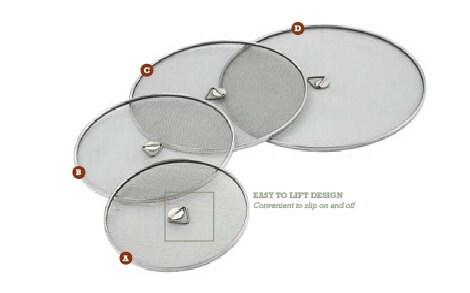 | Net Cover / Food Cover The Net Cover/Food Cover offers a versatile solution for keeping food fresh and protected. View product → |
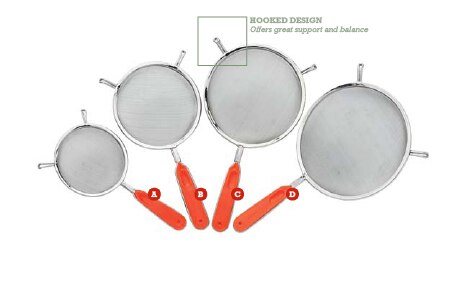 | Mild Steel Strainer And Tin Plated Strainer Mild Steel Strainer And Tin Plated Strainer Mild Steel Strainer and Tin-Plated Strainer are versatile kitchen tools designed for different culinary needs. View product → |
Frequently asked questions
Which stainless steel grade should a manufacturer specify for food covers and strainers?
Require the grade for every wetted part, including mesh, rim, frame, handle, hinge and fastener. Use 304 or 304L for general service; choose 316 or 316L when salt, acidic foods, chloride cleaners or frequent chemical sanitation create a credible pitting risk.
How can you verify a stainless steel mesh opening?
Specify the nominal opening and wire diameter, then compare the approved sample with production measurements. Ask for the tolerance, inspection method and results for each mesh size rather than accepting only a product photograph.
What food-contact documents should a manufacturer provide?
Request a material grade certificate for stainless steel, a food-contact declaration identifying the applicable market, supporting migration or compliance test reports where required, and batch or lot traceability linking documents to the goods supplied.
Which physical details should you inspect before approving a manufacturer?
Check welds for cracks, pits and sharp projections; run a cloth over every edge; examine hinges and handles for looseness; and open and close moving parts repeatedly to detect binding, excessive play or exposed fasteners.
How should you compare manufacturers before placing an export order?
Compare like-for-like samples against the drawing, mesh specification and finish requirement. Review inspection records, corrective-action evidence, packing details, shipping documents and the consistency of the manufacturer’s export file.
Related products
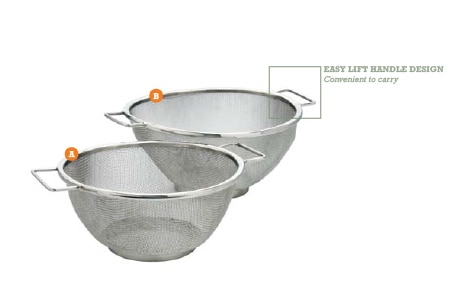 | Wire Mesh Colander / Fruit Basket Wire Mesh Colander / Fruit Basket We are known as a one of the leading Wire mesh strainer factories and Wire mesh Products manufacturers in India. View product → |
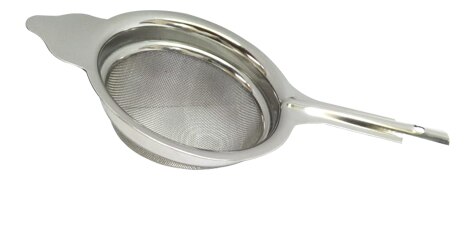 | Cut Strainers Specially designed to suit specific requirements We are leading manufacturers, suppliers and Exporters of Tea Strainer, Coffee Strainer, Wire Mesh... View product → |
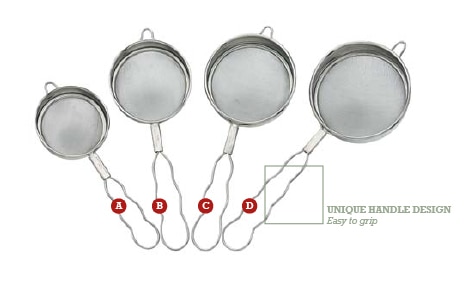 | KitchenStainers Unik Corporation is one of the best tea strainer makers in India, known as a tea strainer manufacturers, wire mesh products manufacturers, wire... View product → |
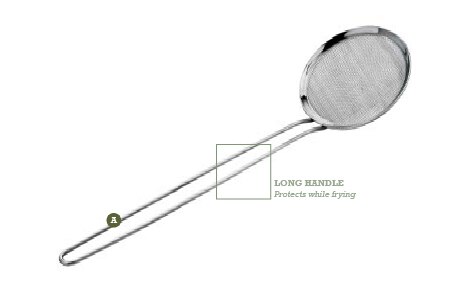 | Net Skimmer / Jara The Net Skimmer, also known as "Jara," is a versatile kitchen tool for removing food items from hot liquids or oil. View product → |