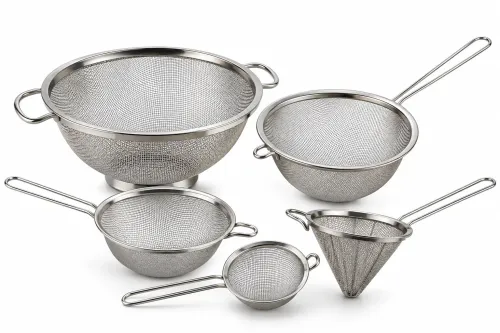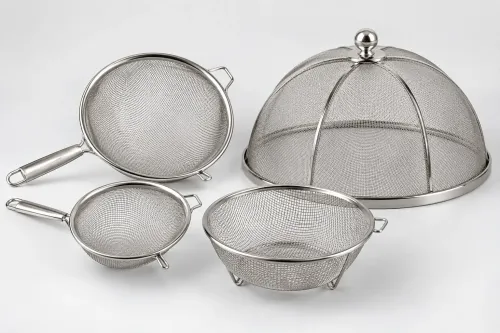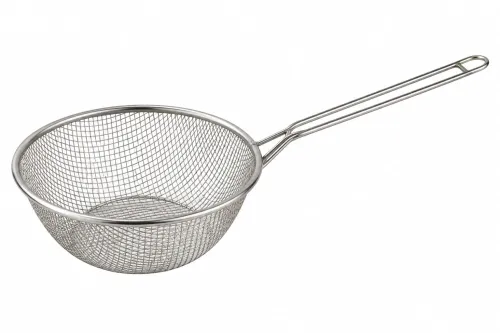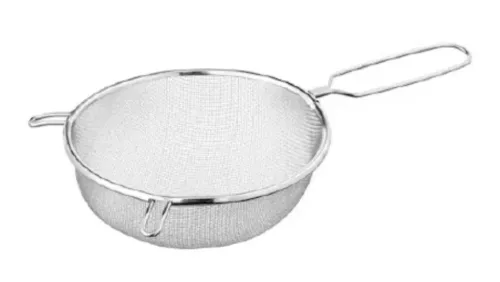
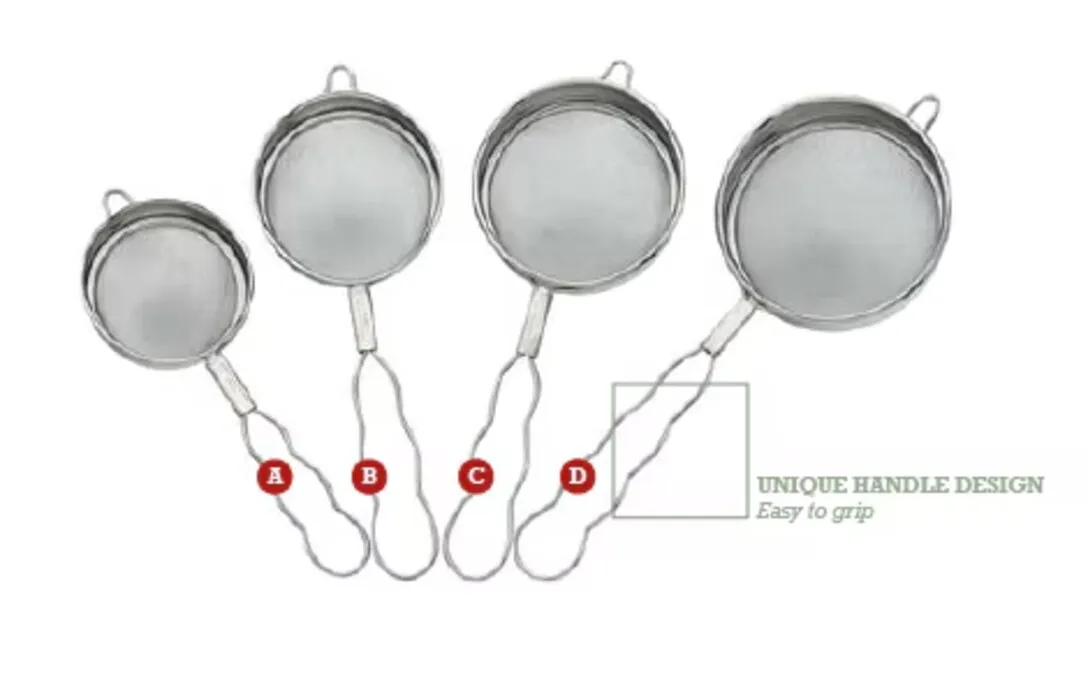
Effective tea filtration depends on matching the mesh opening to the smallest particles you want to retain without choking the infusion flow. By the end, you will know how to compare aperture, mesh construction, basket geometry, vessel fit, safety features and performance evidence before choosing a strainer.
Key takeaways
- Match mesh openings to tea particle size and retention targets.
- Request mesh aperture, wire diameter and construction details—not mesh count alone.
- Size the basket for tea expansion, water flow and the brewing vessel.
- Validate drainage, seam strength, corrosion resistance and cleaning access.
How Mesh Opening Controls Tea Filtration
Mesh opening controls tea filtration by determining which tea particles pass through, how quickly liquor drains, and how much sediment remains in the cup. Match the opening to particle size and a defined retention target, not to a universal mesh-count claim.
- Whole-leaf tea needs a larger opening so expanded leaves do not block flow.
- Broken-leaf tea needs a smaller opening to retain fragments without creating excessive resistance.
- Fannings require finer mesh because their small particles pass through coarse openings.
- Dust tea needs the finest practical opening, but expect slower drainage and faster blinding.
- Tea containing herbs or spices needs an opening that retains the smallest ingredient while preserving usable flow.
Fine mesh raises hydraulic resistance, and swollen leaves or trapped fines reduce the effective open area further. A fast-service strainer therefore needs more total mesh area, not simply a smaller mesh opening.
Mesh count alone cannot specify performance: it counts openings per unit length, while wire diameter changes the actual aperture and open area. Request the nominal aperture in millimetres or micrometres, wire diameter, material, tolerance, and whether the opening was measured.
Validate tea filtration with the intended grade, tea mass, water volume, temperature, contact time, agitation, drain time, and escaped-particle quantity. Clean-water flow is useful, but it will not reveal blinding; test flow again after brewing. Smooth transitions, minimal overlapping layers, and access for brushing prevent retained oils and fines from restricting later brews.
Which Mesh Specification and Construction Should You Request?
Request a measured aperture size, wire diameter, mesh material, weave and tolerance—not just a mesh count. Mesh count records openings per unit length, but wire diameter changes the clear opening and open area; two meshes with the same count can retain different particles.
| Specification | What it tells you | What to request |
|---|---|---|
| Aperture size | The largest nominal passage through the cloth | Millimetres or micrometres, with an allowed tolerance |
| Wire diameter | Strength, open area and actual aperture relationship | The wire diameter in millimetres |
| Mesh count | Openings counted along a defined length | Count stated alongside aperture, never by itself |
| Material and weave | Corrosion resistance, rigidity and cleanability | Stainless-steel grade, such as 304 or 316, plus plain or twilled weave |
| Inspection basis | Whether the claim applies to the finished part | Measured results or dimensional inspection against ISO 9044; ISO 3310-1 can support sieve testing but is not a complete household-strainer specification |
Ask whether the aperture is nominal or measured, and whether the tolerance applies after forming. Stamping, welding, crimping and tensioning can distort openings at the rim or seam, creating leakage paths that a flat incoming-mesh sample will miss.
Choose a rolled or fully covered edge rather than an exposed cut edge. Burrs trap tea and damage cleaning cloths; a rough weld creates a dirt-catching ridge, while a continuous, ground or polished seam closes escape routes without sacrificing cleanability. Verify the central panel, perimeter and finished seam, not only the bulk mesh.
A finer cloth also needs sufficient total area, because swollen leaves and fines can quickly blind it.
How Basket Shape and Size Preserve Flow During Brewing
The basket should be wide enough to spread wet leaves across a broad bed, with depth limited so expansion does not create a compact plug. A stated tea basket capacity based on dry fill volume is misleading: swollen leaves can occupy the headspace and block circulation before the basket appears full.
Compare usable mesh area and bed depth, not millilitres alone. A shallow basket gives water more contact area and lower resistance, while a deep basket holding the same tea mass increases compaction, channeling and uneven extraction. A deep basket is useful only when its diameter, structural support and headspace accommodate the expanded leaves.
Keep the rim above the liquid while placing enough usable mesh below the surface for water to pass through the leaf bed. If the diameter is too small, the submerged area becomes crowded; if the basket is too deep, leaves settle into a dense lower layer.
Ask for the internal diameter, usable depth below the rim and headspace measured to the intended fill line.
A wide or shallow mesh panel needs a perimeter frame or internal ribs to prevent sagging, aperture distortion and separation from the rim. Supports must not form narrow seams where tea collects and cannot be rinsed out.
Check the basket after brewing: retained leaves should spread rather than form a pressed plug, and liquid should drain without prolonged standing or shaking.
How Strainer Formats Prevent Overflow, Bypass and Unsafe Handling
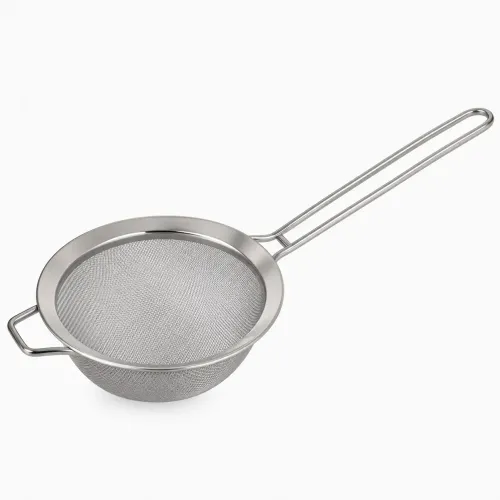
A cup-top basket fits a mug; a teapot insert belongs inside the pot; a saucepan needs a supported basket or pass-through service strainer. Match the format to the vessel’s opening and liquid level, or tea will bypass the mesh, overflow the rim or force you to handle hot metal.
| Format | Best fit | Main control against failure |
|---|---|---|
| Cup-top basket | Mug or cup | A broad, level flange keeps the basket centred and leaves the rim above the liquid. |
| Teapot insert | Teapot | A retaining lip or shoulder stops the insert sliding into the spout or tipping during pouring. |
| Ball infuser | Small mug or teapot | A secure clasp and close-fitting seam limit bypass, but limited volume can crowd expanded leaves. |
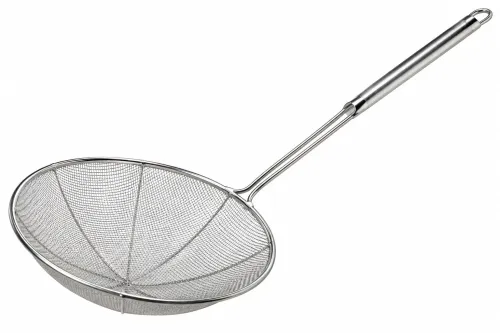
| Pass-through service strainer | Saucepan or commercial vessel | A rigid frame, long handle and receiving vessel support stable transfer without holding the mesh by hand. |
The rim should overlap the vessel opening enough to prevent a side gap, while its underside needs smooth, stable contact points rather than sharp feet that scratch enamel or glass. Keep support legs clear of the active mesh; contact against a wall can seal part of the opening and redirect unfiltered tea around the basket.
Place the handle away from the hottest wall and use a grip that does not become conductive through a thin metal stem. Balance matters: a loaded basket that tilts can immerse its rim, causing overflow and allowing liquid to run over the outside.
For commercial service, a locking or guided frame is safer than a loose strainer passed above a steaming vessel.
How a Manufacturer Validates Filtration, Durability and Cleanability
Request records that prove three things before approving a tea strainer: it retains the intended particles, survives handling and heat, and can be cleaned without trapping residue or creating injury points.
1. Ask for measured aperture data, wire diameter and mesh count for woven mesh, not a “universal tea mesh” claim. ISO 9044 provides a recognized basis for industrial woven wire cloth; ISO 3310-1 can support test-sieve checks, but it does not fully specify a finished household strainer.
2. Require a brewed-tea performance test using your tea grade. The report should state tea mass, water volume and temperature, contact time, agitation, drain time, and escaped-particle quantity. Test both clean-water flow and flow after exposure to fannings or dust, because fine particles can blind woven mesh.
3. Compare the construction against the duty. Perforated metal resists blinding but has fixed hole geometry; expanded metal suits open drainage but is rarely appropriate for fine tea retention. Ask the manufacturer to justify the selected construction against your retention target.
4. Inspect samples for continuous seams, rolled or covered edges, smooth welds, burr-free handles and secure joints. A cut edge can retain tea, snag a cleaning cloth and start corrosion.
5. Run repeated brew, wash and dry cycles, then check for distortion, loose wires, coating loss, rust and blocked openings. Record whether users can reach every surface with a brush or cloth.
Unistar Kitchen Strainers should be able to provide a sample and inspection record that lets you verify these points, rather than asking you to rely on appearance or generic quality language.
Related products
 | Cut Strainers Specially designed to suit specific requirements We are leading manufacturers, suppliers and Exporters of Tea Strainer, Coffee Strainer, Wire Mesh... View product → |
 | KitchenStainers Unik Corporation is one of the best tea strainer makers in India, known as a tea strainer manufacturers, wire mesh products manufacturers, wire... View product → |
Frequently asked questions
How does mesh opening affect tea filtration?
Mesh opening determines which tea particles pass through, how quickly liquor drains and how much sediment remains in the cup. Specify the opening against particle size and a defined retention target.
Which mesh specifications should you request for a tea strainer?
Request the mesh aperture, wire diameter, material grade, weave or perforation method, tolerances and construction details. Compare the stated opening with a sample or inspection report instead of relying on mesh count alone.
How should you size and shape a tea strainer basket?
Choose a basket with enough volume for the tea leaves to expand without blocking the mesh. Match its diameter, depth, support structure and outlet area to the brewing vessel and required drainage rate.
How can a manufacturer validate tea strainer performance?
Test filtration with the intended tea particle range, measure drainage and retained sediment, inspect seams and handles, and check corrosion resistance, cleaning access and repeated-use durability.