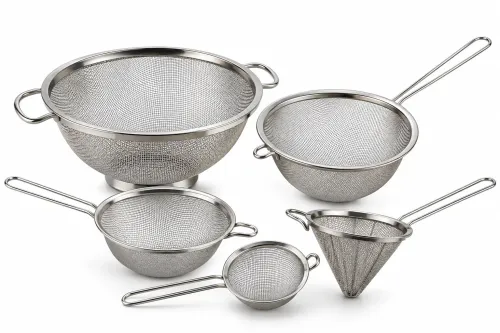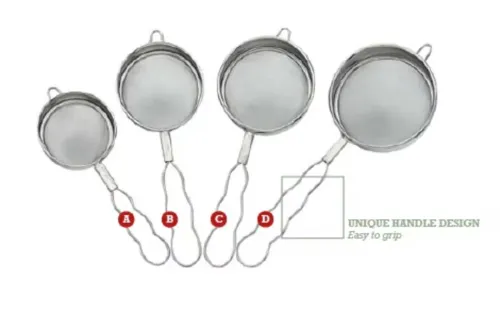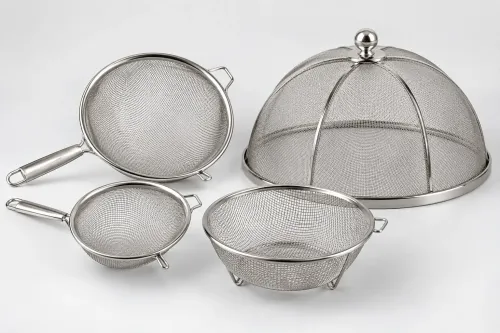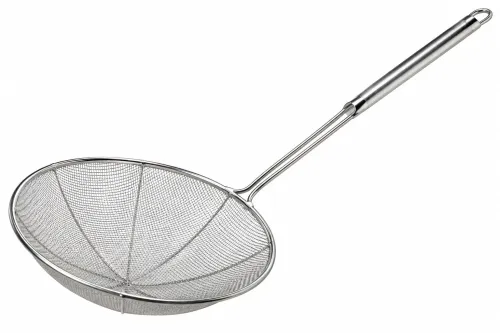
A strip strainer is not interchangeable with a basket, sieve, tea strainer, or perforated plate: its shape, opening pattern, and flow path determine whether it will work in your vessel or processing line. By the end, you will have a practical specification for aperture size, materials, hygiene, testing, tolerances, and supplier quality evidence before you request quotations.
Key takeaways
- Define channel width, flow direction, solids size, and cleaning method before requesting quotes.
- Specify aperture size and retention target instead of relying on mesh count alone.
- Request material grades, weld details, drawings, samples, and traceability records.
- Test the finished strainer for fit, flow, retention, sharp edges, and cleanability.
Start by Defining the Strip Strainer’s Job and Geometry
A strip strainer is a narrow, elongated filtering component built from strip construction, woven wire, perforations, or slots. It directs liquid through a narrow flow path while retaining particles, making it useful for coarse solids removal from a chute, vessel outlet, dispensing line, or long channel.
It is not a substitute for a deep basket when you need high-volume loading or for a sieve that must separate particles across a broad surface.
| Format | Strength | Best kitchen application |
|---|---|---|
| Strip strainer | Long, narrow usable area; fits a defined channel or outlet | Filtering liquid along a chute, drain, or processing line |
| Basket strainer | Deep volume and larger solids capacity | Holding solids while liquid drains from a vessel |
| Sieve or perforated plate | Broad, shallow screening surface | Sorting or screening across a tray or hopper |
Give the manufacturer these dimensions and performance details:
- Overall length and width, plus the strip width and usable straining area
- Opening size, slot length and width, or mesh count with nominal aperture and wire diameter
- Material or strip thickness, flatness requirement, and opening-production method
- Working depth, if the strip sits inside a channel or vessel
- Handle length, mounting points, clearance, and required handle position
- Liquid type, target flow rate, temperature, and the largest particle you must retain
Select a larger opening for faster flow and lower clogging risk; select a smaller opening for finer retention, accepting higher pressure drop and more frequent cleaning. Ask for a drawing showing tolerances rather than approving “20 mesh” alone.
Specify Apertures by Particle Retention and Flow, Not Mesh Count Alone
Choose the smallest nominal aperture that retains the target particle without turning the strainer into a plug. Define the particle size you need to remove, then compare it with the liquid’s viscosity, solids load, and acceptable flow rate. A finer opening improves retention but increases pressure drop and clogging; a coarse opening passes unwanted solids.
Do not specify “20 mesh” or “40 mesh” alone. Mesh count states openings per linear inch, while wire diameter changes the actual opening and open area.
| Specification | What it controls | What to require |
|---|---|---|
| Mesh count and wire diameter | Actual passage size and flow area | Nominal aperture, wire diameter, weave pattern, and tolerances |
| Perforated strip openings | Directional retention, stiffness, and edge behaviour | Opening length and width, strip thickness, burr limits, and production method |
| Aperture distribution | Maximum particle passage | Largest permitted opening, distorted or blocked-opening percentage, and measurement method |
| Flow performance | Pressure loss and clogging risk | Test liquid or defined surrogate, flow rate, pressure head, temperature, and blocked-area condition |
Evaluate woven wire and perforated strip openings as different products. Woven wire usually provides a more uniform aperture field; formed or slit strip construction can offer stiffness but less predictable edge retention. Ask for a sample test using your actual food or liquid.
If the test meets retention only with rapid blockage, increase the opening or usable area rather than accepting an impractical specification.
Compare Metals, Edges, Welds, and Food-Contact Surfaces
304 stainless steel is the practical baseline for many kitchen strip strainers, but 316L stainless steel earns its cost where chloride-bearing water, salt, acidic residues, or frequent chemical cleaning create a defined corrosion risk. Molybdenum improves 316L’s resistance; it does not make either grade immune to concentrated salt, bleach, or trapped food residue.
| Material | Service behaviour | When it applies |
|---|---|---|
| 304 stainless steel | Good heat, moisture, and general food-acid resistance; verify the actual grade and lot | Standard kitchen use with controlled cleaning |
| 316L stainless steel | Better chloride resistance; still vulnerable to bleach and concentrated residues | Salty, coastal, brine, or aggressive wash exposure |
| Mild steel | Corrodes quickly at scratches, welds, and wet edges | Avoid for uncoated food-contact surfaces |
| Tin-plated steel | Tin protects the substrate until worn, scratched, or chemically attacked | Low-abrasion, limited-wash applications with coating inspection |
Specify smooth, fully closed edges rather than rolled folds that trap soil. Inspect the mesh-to-frame joint under magnification for burrs, overlap, spot-weld cavities, incomplete welds, and polishing compound. Those defects hold food and detergent after the open mesh appears clean.
Treat dishwasher resistance as an assembly claim. Require testing of the finished strainer to EN 12875-1, with the detergent, cycle count, dimensional limits, corrosion limit, and weld or handle pass criteria written down.
For EU sales, request a finished-article Declaration of Compliance under Regulation (EC) No 1935/2004; for US sales, request the applicable FDA basis for metal, coatings, plastics, adhesives, or elastomers, including 21 CFR Part 177 where relevant.
Demand Drawings, Samples, Traceability, and Compliance Documents
A signed production drawing is the control document, not a sales sketch. It must state the actual stainless designation, opening-production method, nominal aperture, wire diameter or strip thickness, weave or perforation pattern, overall dimensions, and dimensional tolerances. Without those details, a “20 mesh” replacement can change both particle retention and flow.
Require a pre-production sample made with the intended tooling and materials. Compare it with the drawing, including edge condition, burrs, welds, frame alignment, usable straining area, and any handle or coating. Keep the approved sample or clear measurement record as the batch-release reference.
Ask the manufacturer for these records:
- Material certificate identifying the stainless grade, heat number, and shipment lot
- Inspection report recording aperture, thickness, length, width, and critical dimensional tolerances
- Lot traceability linking the finished strainer to the mesh or strip, frame, weld consumables, and production date
- Change-control and nonconformance procedures showing how substitutions, defects, and rework are contained
- Written declaration of compliance for the finished article, with its supporting test basis
For EU supply, the declaration should address Regulation (EC) No 1935/2004 and manufacturing controls under Regulation (EC) No 2023/2006. For US supply, demand the specific food-contact basis for the metal and each polymer, adhesive, coating, or plating; 21 CFR Part 177 is not blanket approval for a finished strainer.
Ask Unistar Kitchen Strainers to identify these records before you approve tooling, not after inconsistent batches arrive. “Food grade,” “18/8,” or “304 equivalent” alone proves neither composition nor traceability.
Build Acceptance Tests Around the Finished Strainer
Set pass/fail limits before the shipment arrives, then use a pre-shipment inspection report to confirm that the same limits were checked at the factory. Separate critical defects from sampling defects: sharp edges, exposed wire ends, open welds, loose handles, and food-contact contamination should normally have zero acceptance.
1. Sample the lot under ISO 2859-1 and record the lot size, inspection level, AQL, and rejected units. Do not let an AQL plan excuse a single critical safety defect.
2. Measure overall length and width, strip width, material thickness, working depth, handle position, and frame flatness against the approved drawing. Check that the strainer sits correctly in its intended chute, vessel, or support.
3. Require an aperture-distribution report, not just a visual check. It must state the measurement method, largest permitted opening, nominal opening, and percentage of blocked or distorted openings; verify a sample with calibrated gauges or optical measurement.
4. Inspect every food-contact edge for burrs, sharp points, exposed ends, pits, stains, incomplete welds, distortion, and trapped oil or polishing compound. Wash and rinse samples before use, then confirm that no residue or metallic particle remains.
5. Run the finished strainer with the actual liquid and representative solids. Record flow, retained particles, leakage around edges, clogging, and handle stability; reject it if coarse particles pass through the largest allowed opening.
6. For dishwasher use, test the complete assembly to EN 12875-1 using your detergent, cycle count, and pass limits for corrosion, distortion, staining, weld damage, and handle loosening. Treat salt-spray data as finish comparison evidence, not a service-life guarantee. Verify material certificates; a magnet cannot distinguish 304 from 430 reliably.
Frequently asked questions
What should you define before choosing a strip strainer manufacturer?
Define the strainer’s channel width, length, flow direction, installation point, particle size, liquid type, cleaning method, and expected throughput.
Why is mesh count alone insufficient for specifying a strip strainer?
Mesh count does not fully describe retention or flow. Specify the actual aperture, wire diameter or slot dimensions, open-area requirement, and target particle size.
Which material and fabrication details should you compare?
Compare the stainless steel grade or other metal, strip thickness, edge finish, weld quality, joint design, corrosion resistance, and the smoothness of every food-contact surface.
Which documents should a strip strainer manufacturer provide?
Request an approved drawing, material grade evidence, sample, batch or heat traceability, inspection records, food-contact declarations where required, and cleaning or care instructions.
How do you test a finished strip strainer before acceptance?
Check dimensional fit, flow performance, particle retention, leakage around edges, weld integrity, burrs, sharp points, deformation, and cleanability under the intended process conditions.