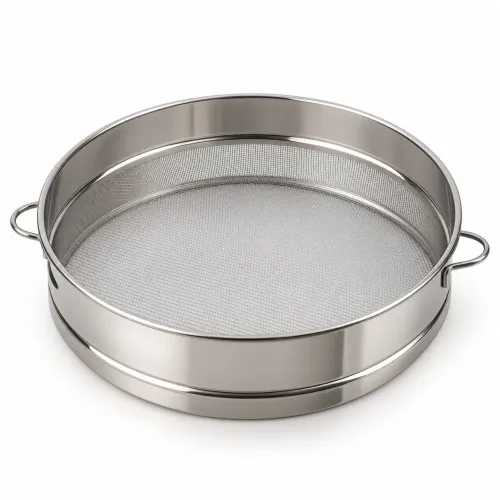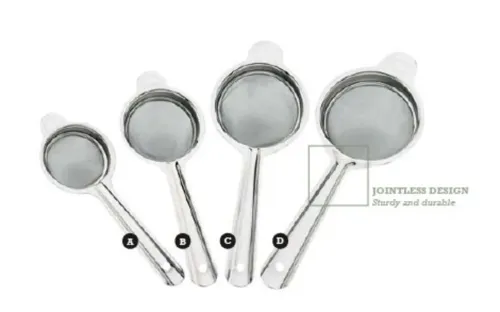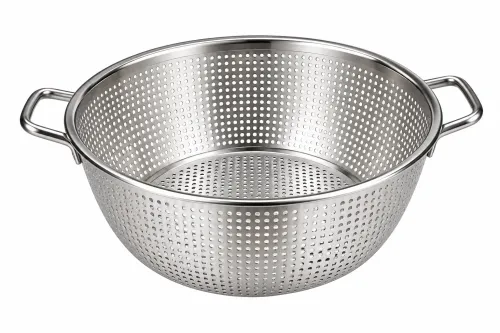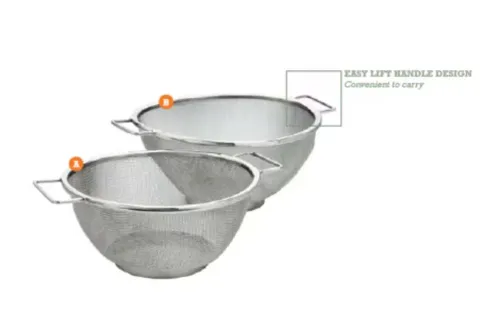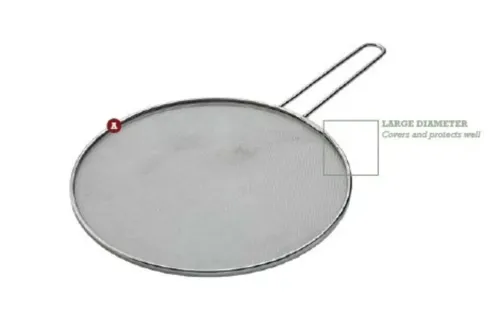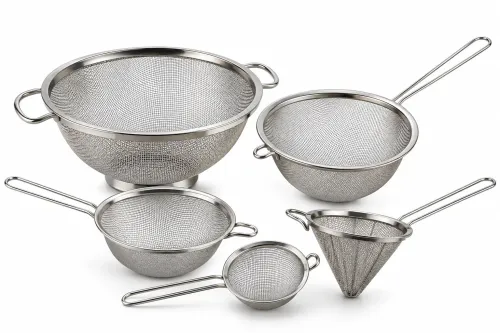
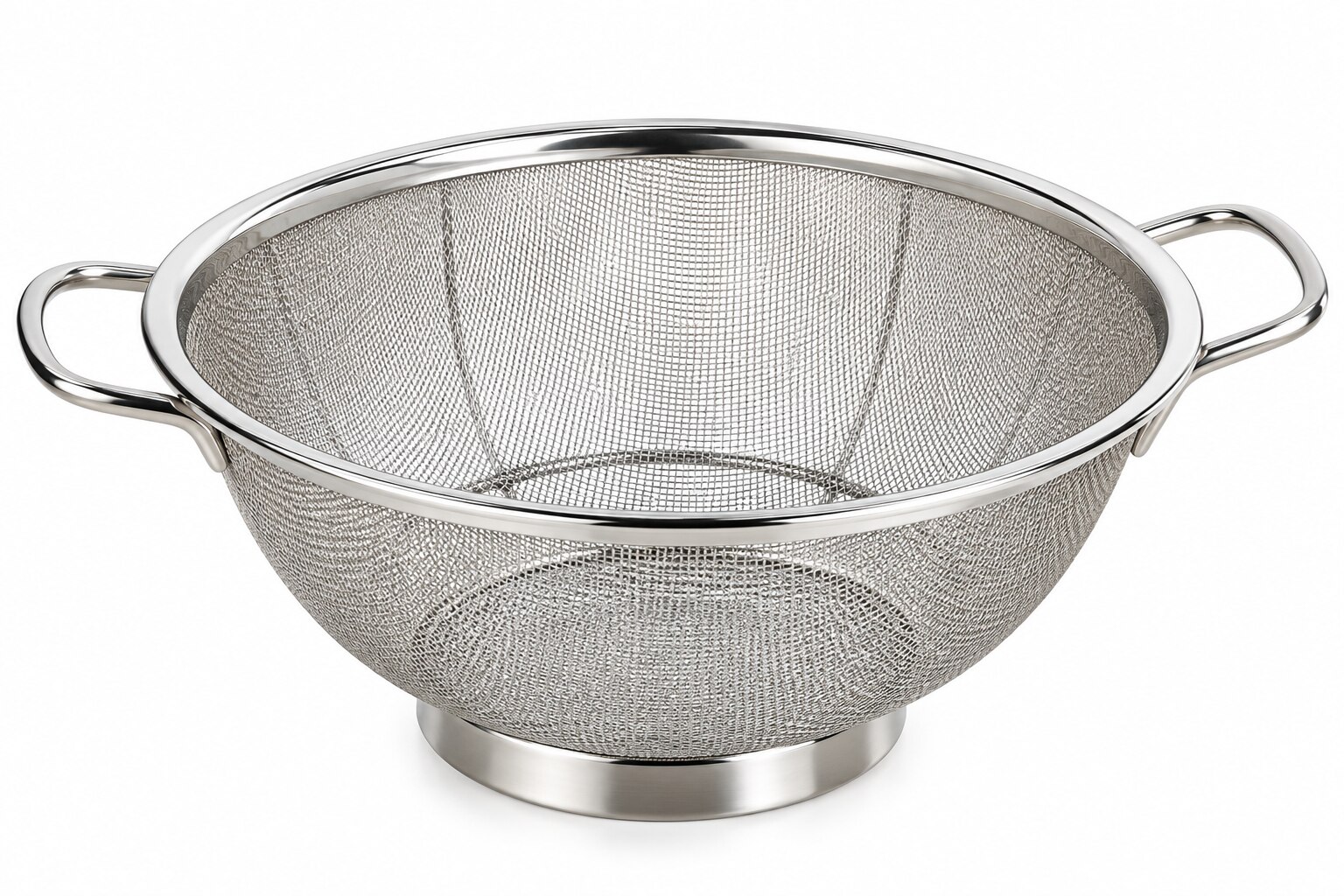
A net colander is not interchangeable with a perforated colander, sieve, or fine-mesh strainer, and a quoted mesh count does not tell you how it will perform. By comparing aperture, materials, construction, dimensions, testing, and export controls, you can turn a catalogue choice into a specification a manufacturer can verify.
Key takeaways
- Specify aperture size against the food you need to drain.
- Request food-contact declarations and material grade records.
- Inspect mesh joins, rim seams, handles, and cleanable surfaces.
- Confirm load tests, final inspection records, and export documents.
Define the Net Colander by Its Aperture and Intended Food
A net colander definition is a basket made from woven wire mesh or welded mesh, with openings across the mesh field and a rim, handle, and base arranged for washing or draining. A perforated metal colander comparison matters: its holes are punched into sheet metal, while a wire basket prioritises containment over controlled separation.
A sieve separates particles by size, and a fine-mesh strainer retains smaller particles at the cost of slower drainage.
| Option | Construction | Main purpose |
|---|---|---|
| Net colander | Woven or welded wire mesh | Washing and draining food |
| Perforated metal colander | Punched sheet-metal holes | Rigid draining and rinsing |
| Wire basket | Open wire structure | Containment and handling |
| Sieve | Controlled screening surface | Particle-size separation |
| Fine-mesh strainer | Small openings | Retaining fine solids |
Specify nominal aperture in millimetres, wire diameter, open-area percentage where relevant, and permitted tolerances. Mesh count alone is inadequate: identical counts produce different openings when wire diameters differ. ISO 9044 and ASTM E2016 offer useful woven-wire references; ISO 3310-1 test sieves have controlled apertures, frames, and inspections that ordinary colanders do not meet.
Match the opening to the food. Coarse mesh drains pasta and rinses large produce quickly; intermediate mesh suits rice and berries; fine mesh retains lentils and stock particles but drains slowly. Throughput also changes with viscosity, particle shape, solids loading, and whether you press food through the mesh.
Compare Metals, Coatings, and Food-Contact Documentation
“Stainless steel” is not a sufficient purchasing specification. Compare the material, its failure mode, and the evidence supporting food contact before approving a net colander.
| Option | Main trade-off | Check before buying |
|---|---|---|
| 304 stainless steel | Common general-purpose choice; resists ordinary kitchen corrosion. | Confirm grade and material standard. |
| 316 stainless steel or 316L | Molybdenum improves resistance to chloride-containing environments, but increases cost. It still corrodes from trapped residues, crevices, poor cleaning, or iron contamination. | Confirm the grade, certificate, and cleaning conditions. |
| Mild steel | Low cost but rusts when moisture reaches the substrate. | Reject exposed metal for wet food use. |
| Galvanised iron | Zinc coating delays rust; abrasion, heat, and acidic food can wear it away. | Check coating integrity and exposed-substrate risk. |
| Tin-plated steel | Tin protects the base metal until scratches or wear expose it. | Inspect edges, seams, and coating limits. |
| Aluminium | Lightweight but dents easily and can react with some foods or cleaners. | Confirm food-contact suitability and temperature limits. |
| Plastic | Does not rust, but can retain odours, deform with heat, or crack and expose its substrate. | Obtain the resin grade, temperature limit, and food-contact basis. |
Request the grade designation, applicable material standard, heat or batch traceability, and a material certificate when corrosion exposure or regulatory scrutiny matters. For stainless parts, ask whether passivation followed ASTM A967/A967M or an equivalent requirement. Passivation removes free iron; it is not a decorative coating and cannot repair poor welds or sharp crevices.
- For EU sales, obtain a declaration of compliance covering Regulation (EC) No. 1935/2004 and, where relevant, Regulation (EC) No. 2023/2006.
- For US sales, require the applicable FDA legal basis and conditions of use, and assess equipment against NSF/ANSI 51 where required.
- Make every document state the intended food, temperature, contact time, cleaning chemicals, and coating or plastic limits.
Inspect the Mesh, Rim, Joints, and Cleanable Surface
Reject a sample or production lot if the mesh looks clean but the perimeter retains food or cleaning chemicals. Inspect wire diameter, aperture uniformity, mesh tension, deformation, sharp cut ends, and burrs across the basket, not just at one point.
- Examine the rim reinforcement and mesh-to-frame joint for unsealed gaps, exposed wire, folded edges, loose caps, and crevices around handle attachments.
- Specify limits for pits, scratches, discoloration, burrs, and weld defects; “polished” and “mirror finish” are not measurable requirements.
- Where cleanability is critical, name the roughness method and maximum value. A bright surface can still hide a rough weld.
- Ask whether a damaged handle, rim, or mesh section is replaceable, rather than treating the entire colander as disposable.
| Construction | Advantage | Inspection risk |
|---|---|---|
| Jointless colander | Continuously formed edges reduce crevices | Check that forming has not thinned or cracked the edge |
| Welded mesh | Holds aperture geometry and resists local wire movement | Inspect welds for pits, cracks, roughness, and incomplete fusion |
| Woven mesh | Supports finer filtration and flexibility | Cut edges can fray; impact can alter aperture or tension |
| Soldered or mechanically joined | Can simplify assembly or repair | Check residue, loosening, trapped food, and repair access |
Clean around folded or capped edges and the handle joint during testing. These perimeter areas often present more hygienic risk than the open mesh field.
Match Dimensions, Stability, and Strength to the Workstation
A colander that fits the basket but not the workstation is a failed purchase. Define the clear opening needed for the sink, stockpot, preparation bowl, or commercial washing station before comparing samples.
Specify these dimensions on the drawing:
- Rim diameter and basket depth
- Internal usable volume and usable capacity
- Overall height and handle length
- Wire diameter and nominal aperture
- Clear opening beneath the rim, if the basket must sit inside another vessel
Ask for internal usable volume, not outside dimensions alone. A thick rim, sloping sides, or a long handle can make a seemingly large colander hold less food than expected.
Examine the foot or base. Supports need enough clearance beneath the basket for water to escape, while the rim and base must stop a loaded basket from tipping or shifting when pushed under a tap.
Test the grip with wet hands; check whether the handle strikes the sink, obstructs the stockpot, or makes the basket rotate during draining.
Require a defined static load, off-axis load, and repeated-use or cycle test for the handle and rim. After testing, inspect for cracked welds, permanent deformation, loosened joints, or changed aperture. “Reinforced handle” means little without a specified handle load test and method.
When assessing Unistar Kitchen Strainers, request drawings, tolerances, load results, and confirmed base clearance with samples or a quotation. The complete basket must remain stable under use, not merely show the requested mesh opening.
Related product
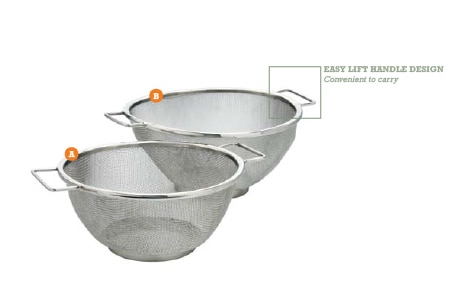 | Wire Mesh Colander / Fruit Basket Wire Mesh Colander / Fruit Basket We are known as a one of the leading Wire mesh strainer factories and Wire mesh Products manufacturers in India. View product → |
Qualify the Manufacturer’s Inspection and Export Controls
A capable manufacturer proves its process with records, not catalogue adjectives. Manufacturer qualification starts with a controlled drawing that states aperture, wire diameter, open area, rim construction, handle attachment, dimensions, and tolerances.
1. Request a sample quality inspection report covering mesh uniformity, sharp ends, welds or seams, finish defects, dimensions, and deformation after loading. Require a defined static, off-axis, or repeated-use handle test; “reinforced handle” means little without a load and method.
2. For wet or sticky foods, demand throughput results using a named product, quantity, water condition, loading method, and drain time. Mesh size alone cannot predict performance because viscosity, particle shape, solids loading, and pressing affect drainage.
3. Confirm lot identification, heat or batch traceability, and a documented complaint or recall process. For food-contact compliance, ask for the material grade, applicable standard, and certificate supporting claims such as food grade, FDA approved, or rustproof; reject any claim without its test conditions.
4. Treat export packaging as part of product quality. Specify individual protection where surfaces rub, dry packing, resistance to condensation and salt exposure, strong cartons, and separation from dirty or dissimilar metals. Ask how storage and sea or road transport prevent corrosion and contamination.
Score evidence rather than adjectives: documented material grade, defined aperture, cleanable construction, tested handle strength, stable dimensions, repeatable inspection, and traceable lots. That comparison exposes suppliers who repeat specifications without controlling production.
Frequently asked questions
How do you choose the right net colander aperture?
Match the opening size to the smallest food particles you need to retain and the drainage speed your process requires. Test the mesh with the actual food before placing a production order.
Which materials and documents should a net colander manufacturer provide?
Ask for the stainless steel grade, coating specification if used, food-contact declaration, material certificate, and test records for any coating or surface treatment.
What should you inspect on a wire-mesh colander?
Check the aperture consistency, welded or woven joints, rim attachment, handle connection, base stability, sharp edges, trapped gaps, and surfaces that are difficult to wash and sanitise.
How do you qualify a manufacturer for commercial or export orders?
Review its incoming-material checks, mesh and dimension inspections, load testing, final release records, packaging controls, batch traceability, and export documents for your destination.