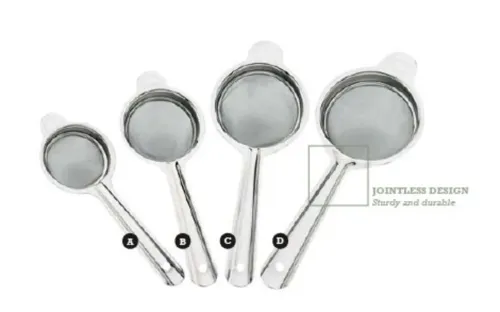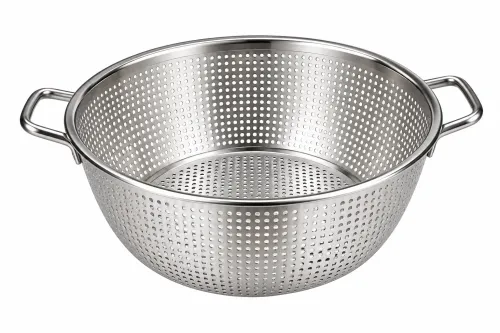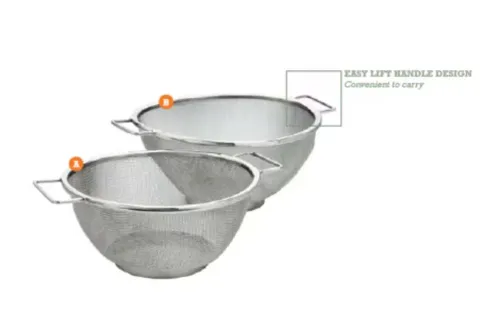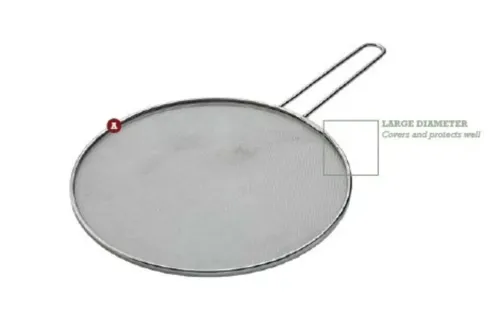
A sieve that works for fine flour can fail on wet pulp, hot stock or oily tea residue because aperture, wire thickness, support and metal grade all change the result. By the end, you will be able to specify the opening, construction and material a manufacturer must test for your product instead of relying on mesh count alone.
Key takeaways
- Choose aperture by target particle size, not mesh count alone.
- Use fine mesh for powders and stronger drainage designs for liquids.
- Match frame metal and surface treatment to moisture, heat and cleaning.
- Test separation rate, capacity and durability before approving a sieve.
How the material determines the sieve aperture
Choose the sieve aperture from the size of the material you need to retain, not from mesh count alone. A manufacturer examines the unwanted particles, sets a clear opening slightly smaller than the target oversize, then checks whether the remaining material passes at the required rate.
An aperture that is too small improves retention but causes slower flow, surface blinding and frequent cleaning.
| Material or target | Starting aperture decision | Throughput risk |
|---|---|---|
| Fine flour or powdered sugar | Use a fine, uniform sieve aperture to remove lumps | Blinding from compacted powder |
| Coarse atta or bran | Choose an opening below the unwanted bran size | Larger particles can clog the surface |
| Tea leaves | Match the aperture to the desired leaf grade, allowing for leaf shape | Flat fibres can bridge across openings |
| Stock or pulp | Use a coarser, supported opening for bones, seeds or fibres | Fine mesh creates high resistance and traps solids |
Specify the nominal sieve aperture and wire diameter together. Mesh size or mesh count describes the number of openings per length, but two meshes with the same count can have different openings because their wire diameters differ.
For plain square woven mesh, open area is approximately [a/(a+d)]², where a is the aperture and d is wire diameter; thicker wire reduces flow at the same pitch.
- Run a representative trial batch.
- Measure throughput and inspect retained oversize.
- Increase exposed sieve area or aperture if flow is inadequate; reduce the aperture if unwanted material passes.
Particle shape, moisture and agglomeration still affect passage, so a nominal aperture is not an absolute cut-off.
Why powders, tea and liquids need different screening designs
Moisture and viscosity decide whether a screen separates material or simply becomes a plug. Dry powder screening suits a taut woven mesh, but damp flour forms a film over fine openings; powdered sugar cakes when humidity rises. Increase exposed area, reduce loading depth or add vibration and cleaning access before choosing a finer aperture.
Tea leaves need a different balance: fibres bridge small openings, while broken particles pass through. A larger, supported mesh area prevents bridging and protects the leaves from crushing. A removable insert also makes trapped stems and dust easier to remove.
For liquid filtration, design around flow resistance rather than dry particle size. Thick stock, syrup or pulp needs larger open area, stronger support and access for rinsing or backwashing; a fine cloth that works for water can collapse or blind under pressure.
Hot liquids add thermal expansion and burn risk, so the frame, joint and handle need heat-resistant construction and secure support.
Check the material before selecting the screen:
- Moist or fatty material: use a less aggressive aperture, more screening area and a removable or washable insert; expect surface blinding.
- Sticky powder: prevent deep loading and provide scraping or vibration access rather than relying on a finer mesh.
- Fibrous tea or pulp: use a larger opening or pre-screen, with enough clearance to stop fibres forming a mat.
- Hot, viscous liquid: choose a rigid perforated support or backed mesh, allow for thermal movement and keep pressure drop low.
- Watery liquid with fine particles: use fine woven mesh only when it remains tensioned and easy to flush clean.
How the frame and mesh survive real kitchen use
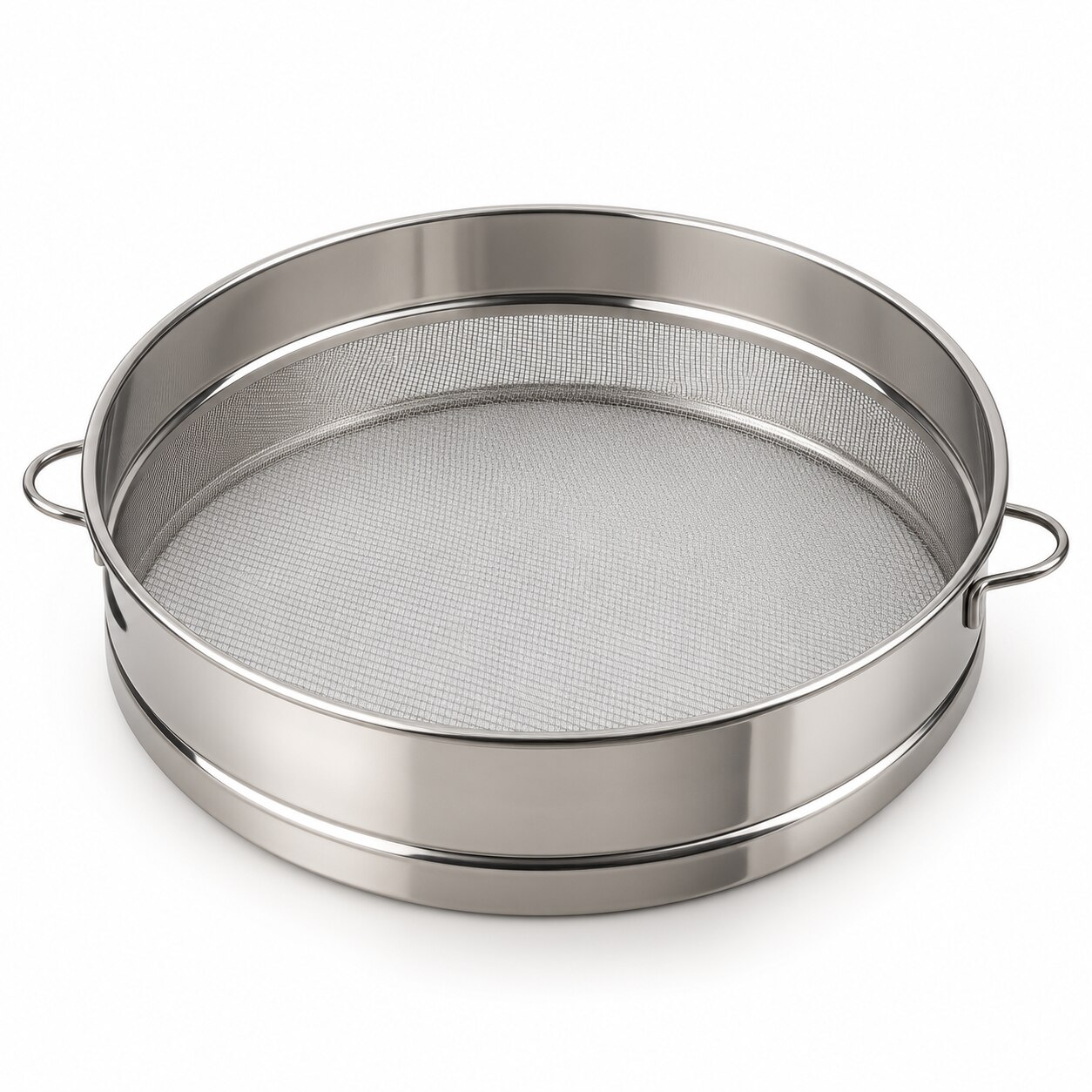
A sieve stays stable, hygienic and functional when its frame supports the mesh instead of merely holding its edge. Frame depth resists twisting under a heavy load, while a rigid rim prevents the body from flexing as you pour, scrape or tap material through it.
Fine mesh needs extra support. A backing mesh, perforated support plate or closely spaced frame stops the working cloth from bowing into the product stream; without it, repeated loading can permanently stretch the mesh and enlarge openings near the edge. High mesh tension helps, but tension alone cannot compensate for weak support.
| Construction detail | Failure it prevents | What to inspect |
|---|---|---|
| Backing mesh or support plate | Sagging, stretched openings and uneven flow | Continuous support beneath fine cloth |
| Deep frame | Twisting and collapse during loading | Sufficient sidewall depth for the intended batch |
| Rigid rim | Flexing while pouring or scraping | A rim that stays circular under hand pressure |
| Rolled or welded edge | Burrs, exposed wire and product traps | Smooth, closed mesh-to-frame joint |
The mesh-to-frame joint deserves a separate inspection from the mesh aperture. A rolled, folded or continuously welded edge shields wire ends and leaves fewer crevices for flour, tea or pulp; exposed cut mesh, intermittent welds and poorly closed seams complicate washing and harbour residue.
Choose a coarser but stiffer sieve when users scrape aggressively or handle concentrated loads. A laboratory test sieve is not automatically suitable for kitchen pouring, washing and impact, which demand greater structural margin. After cleaning, check for loosened joints, bent rims and permanent mesh sag before reuse.
Which metal and surface treatment fits the working environment
Choose a stainless steel sieve for routine food contact, repeated washing and long service life. Type 304 stainless steel suits most dry ingredients, stock and kitchen cleaning; type 316 stainless steel adds resistance to chloride-rich brines, harsh cleaners and coastal air through its molybdenum content. Neither grade is immune to pitting in concentrated chlorides.
| Material | Food contact and corrosion | Cleaning and cost |
|---|---|---|
| Stainless steel | Best default; 304 handles general use, while 316 suits chloride exposure | Tolerates frequent washing; higher purchase cost, lower rust-related replacement risk |
| Mild steel | Lowest-cost option, but exposed steel rusts and is unsuitable for wet food contact without a suitable coating | Dry use only unless protected; avoid prolonged soaking and aggressive cleaning |
| Tin-plated steel | Tin provides a food-contact barrier while the coating remains intact | Economical for dry, non-acidic use; scratches, abrasion and acidic foods expose the underlying steel |
| Galvanised iron | Zinc coating resists initial rust but is a poor choice for acidic, salty or hot food contact unless local requirements specifically permit it | Low to moderate cost; avoid abrasive scrubbing that removes zinc |
Ask Unistar Kitchen Strainers to state the base metal, coating, intended food-contact use and cleaning limits rather than accepting “metal sieve” as a specification.
For stainless steel, passivation removes free iron and strengthens the protective oxide surface; electropolishing removes a controlled layer to reduce roughness and burrs. Neither treatment fixes crevices, exposed cut wire or chloride attack.
Related products
 | Inter Changeable Sieves Interchangeable Sieves offer versatile sifting solutions for diverse culinary needs. View product → |
 | Atta Sieves Atta Sieves, also known as Fixed Sieves, are specialized tools designed for sifting flour and other dry ingredients. View product → |
How a manufacturer verifies capacity, separation and service life
A nominal mesh count does not prove a finished sieve’s performance. The actual aperture depends on mesh count and wire diameter, so two sieves with the same count can have different flow rates and separation results.
The manufacturer measures the clear openings, records wire diameter, and checks the usable open area after allowing for the rim, welds, ribs and support plate.
For a sieve sold as a measurement device, aperture and construction checks should follow ISO 3310-1 for woven wire test sieves. A household strainer is not automatically compliant because its stated mesh count resembles an ISO designation.
Perforated sheet requires a separate check of hole size, bridge width, pattern and open area; its stiffness can improve support while reducing flow.
Finished-sieve verification should include these trials:
- Capacity: pass a known mass or liquid volume through the sieve for a measured time, then compare throughput with the specification.
- Separation: use a representative batch, weigh the retained and passed fractions, and check oversize carryover or unwanted fine material in the retained fraction.
- Service life: repeat loading, scraping, washing and drying cycles, then inspect for stretched woven wire mesh, blocked openings, loose joints, bent perforated sheet or frame distortion.
A sieve that passes an aperture check but collapses under concentrated loading has not met its real use requirement. Manufacturers therefore test the complete assembly, not just a loose mesh sample.
Frequently asked questions
How do you choose a sieve aperture for a material?
Set the clear opening slightly smaller than the unwanted particles you need to retain, then verify that the usable material passes at the required rate.
Why do powders, tea and liquids need different sieve designs?
Powders need controlled fine openings, tea needs openings that separate leaves without excessive blockage, and liquids need mesh and support that drain efficiently without distortion.
What helps a sieve survive repeated kitchen use?
A rigid frame, securely joined mesh, suitable metal and a surface treatment that withstands moisture, heat and cleaning protect the sieve during service.
How does a manufacturer verify sieve performance?
The manufacturer checks aperture consistency, separation results, throughput, load capacity, cleaning conditions and repeated-use durability.
Related products
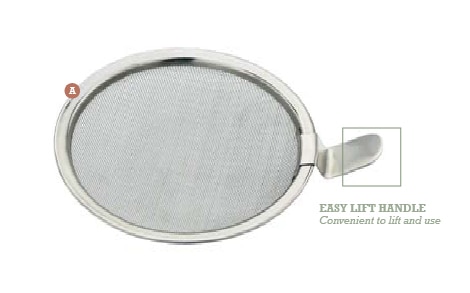
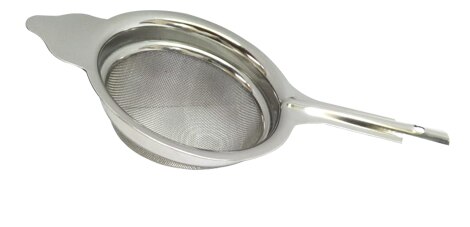 | Cut Strainers Specially designed to suit specific requirements We are leading manufacturers, suppliers and Exporters of Tea Strainer, Coffee Strainer, Wire Mesh... View product → |
 | Filters and Sink Strainers Filters and sink strainers are essential kitchen accessories for maintaining cleanliness and preventing clogs. View product → |
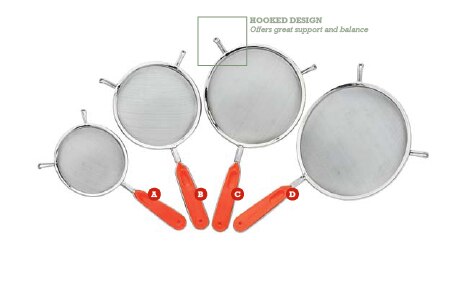 | Mild Steel Strainer And Tin Plated Strainer Mild Steel Strainer And Tin Plated Strainer Mild Steel Strainer and Tin-Plated Strainer are versatile kitchen tools designed for different culinary needs. View product → |
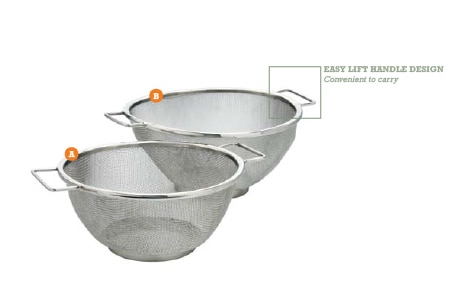 | Wire Mesh Colander / Fruit Basket Wire Mesh Colander / Fruit Basket We are known as a one of the leading Wire mesh strainer factories and Wire mesh Products manufacturers in India. View product → |