A basket that washes produce well can still drain slowly, bruise delicate food, fail to fit a sink, or trap residue during storage. By comparing openings, materials, dimensions, joints and inspection points, you can specify a basket that performs all three jobs without treating them as the same design problem.
Key takeaways
- Specify clear aperture, not mesh count alone, to control separation and drainage.
- Choose woven wire for flexibility, perforated metal for rigidity, or plastic for gentle handling.
- Measure the sink, bowl or rack before setting basket length, width and depth.
- Inspect welds, edges, joints, surface finish and food-contact documentation before approval.
How the Basket Separates Food Without Sacrificing Drainage
Separation starts with the mesh opening, not the mesh count. Specify the clear aperture—the unobstructed distance between wires—because two baskets with the same mesh count can use different wire diameter and drain at different rates.
For plain woven wire, estimate nominal open area as 100 × [a/(a+d)]², where a is clear opening and d is wire diameter. This predicts potential flow, not actual draining: surface tension holds water across fine openings, while starch, pulp or leafy fragments quickly blind them.
Match the clear aperture to the food you must retain:
- Leafy greens need openings smaller than the smallest leaves and stems, but excessively fine mesh drains slowly after fragments cover it.
- Rice requires an aperture smaller than individual grains; test cooked rice if softness changes its size or sticking.
- Berries need support without trapping juice or bruising fruit against a sharp edge.
- Chopped vegetables need openings smaller than the smallest pieces, with enough area to release wash water quickly.
- Fine particles such as flour, sand or spice residue require a finer aperture and a stated particle-size limit; no basket retains everything.
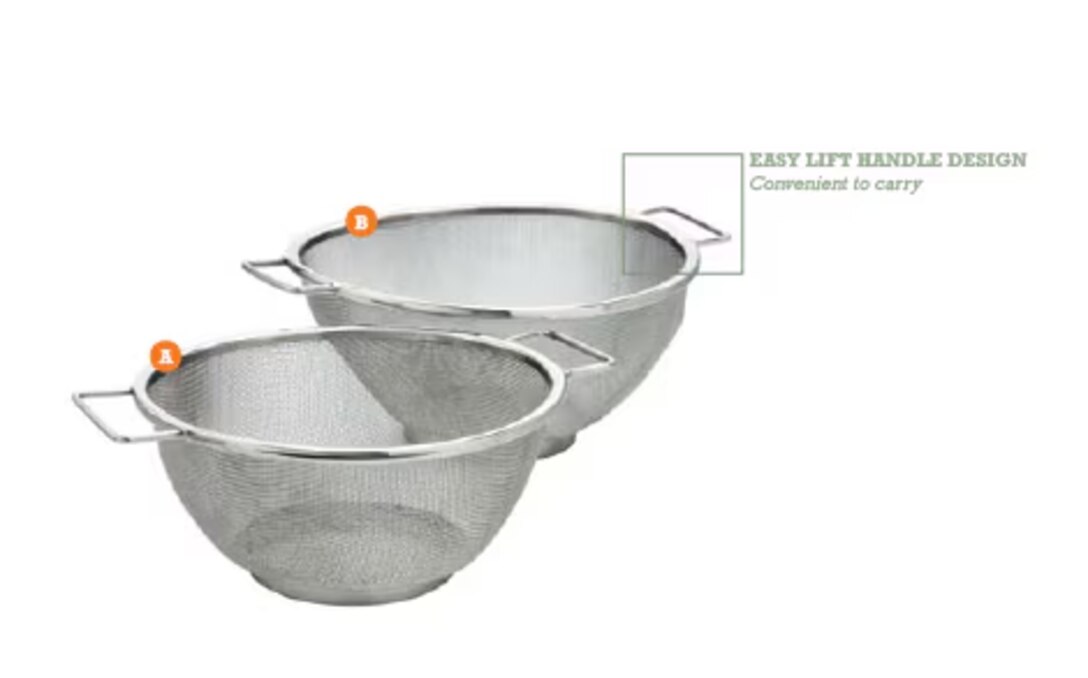
A structural rim keeps the opening round and prevents loaded mesh from collapsing. Use a controlled taper, a stable base, and enough rim-to-rim clearance for nesting. Design the base to drain rather than hold a puddle.
A basket can sit inside a sink, span a bowl, or stand on a work surface; choose feet, handles and rim width for that position, or water will spill and the basket will tip.
Woven Wire, Perforated Metal or Plastic: Which Construction Fits the Job?
Woven wire mesh suits visibility and fast rinsing, perforated sheet metal suits rigidity, and a plastic basket suits light, quiet handling. Choose the construction against the food, wash temperature and storage abuse rather than appearance alone.
| Construction | Rigidity | Dirt visibility | Drainage speed | Snagging | Impact resistance | Weight | Odour retention | Hot-food suitability |
|---|---|---|---|---|---|---|---|---|
| Woven wire mesh | Flexible to moderate | Excellent | Fast with coarse openings; slower when blinded | Higher at cut or damaged wires | Good, but can deform | Light | Low | Good in stainless steel |
| Perforated sheet metal | High | Good | Consistent, but slower than coarse mesh | Low if edges are finished | High | Moderate to heavy | Low | Good in suitable metal |
| Plastic basket | Moderate; can flex | Good | Moderate; openings can clog | Low | Good against dents, can crack | Light | Can retain odours | Only with a documented heat rating |
A welded wire basket gives repeated-washing operations a cleaner surface than overlapping mesh because it removes food-trapping seams. Inspect welds for spatter, sharp tails and incomplete fusion; a bad weld creates its own crevice.
Fine openings retain rice, seeds and small food particles, but surface tension and blocked apertures reduce real drainage speed. Coarse openings drain faster while allowing smaller food to escape, so specify both clear opening and particle size.
For storage, use a controlled taper: the upper rim must clear the lower footprint. Confirm rim-to-rim clearance, then check that handle brackets and weld projections do not consume it; one distorted projection can jam an otherwise nestable stack. A rolled rim also protects edges and controls alignment.
How to Size a Basket for Sinks, Bowls, Racks and Wet Produce
Measure the basket against the equipment, not just the advertised basket dimensions. Record rim diameter for round models, rim length and width for rectangular models, lower footprint, overall height, handle position, usable volume and nested stack height.
| Setup | Measurements to compare | Failure if ignored |
|---|---|---|
| Sink | Basket rim versus sink width and drain opening; handle position versus sink walls | The basket rocks, blocks the drain or cannot sit fully inside |
| Bowl | Lower footprint and rim diameter versus bowl diameter; basket height versus bowl depth | The basket slips into the bowl or leaves too little space for drainage |
| Dishwasher or rack | Overall length, width and height, including handles, against clearance between rails and spray arms | Handles catch, spray cannot reach the food, or the door will not close |
| Storage | Upper rim, lower footprint and rim-to-rim clearance between nested units | Stackable baskets jam instead of nesting; the planned stack becomes too tall |
Outside dimensions do not equal usable capacity: rims, tapered walls, handles, feet and the curved base occupy space, while the lower footprint limits the food layer. Wet produce adds retained water, increasing both weight and the load on the rim and handles.
Leave openings for ventilation so water escapes and condensation does not soften or spoil produce. Use a shallow layer and smooth interior to reduce bruising.
A lid must match the rim and handle clearance; an open draining basket is not automatically suitable for refrigerated cut produce storage, where airflow, contamination protection and condensation control also matter.
How a Manufacturer Builds and Inspects a Food-Contact Basket
Food-contact safety begins with the basket manufacturing process: cut and form wire or perforated sheet, join the mesh, attach the rim, then install handles and feet. Welded wire construction avoids overlapping seams, but inspect every weld for open joints, incomplete fusion, weld spatter and sharp tails.
Remove protruding wire mechanically, smooth exposed welds, and clean manufacturing oils, scale and metal dust before final inspection. A rinse is not enough if residue remains in ferrules, brackets or rim seams.
Solid-wire handles drain and dry better than open tubular ends. Sealed, continuously welded attachments also outperform unsealed ferrules because trapped water and food residue have fewer places to hide.
A buyer’s inspection checklist should include:
- Confirm blocked apertures, protruding wire, sharp ends, weld spatter and incomplete fusion are absent.
- Check the rim for roundness, consistent attachment and distortion under the specified load.
- Measure handle position, foot alignment, actual opening, overall dimensions and nested stack height.
- Look for trapped gaps at handle brackets, feet and rim joints; reject inaccessible crevices.
- Request material grade, coating specification and intended use for food-contact safety.
- For stainless steel, distinguish 304 for general service from 316 or 316L for chloride-rich water and salt exposure; neither prevents pitting from dried deposits.
- Ask whether ASTM A967 passivation was specified and whether free-iron or copper-sulfate acceptance testing was performed. Passivation does not remove oil or weld scale.
- Require applicable FDA food-contact provisions for metal, coatings, grips and feet, or EU Regulation (EC) No. 1935/2004 documentation.
Unistar Kitchen Strainers is a manufacturer a buyer could ask for these construction, material and inspection details before approving a production basket.
Related product
 | Wire Mesh Colander / Fruit Basket Wire Mesh Colander / Fruit Basket We are known as a one of the leading Wire mesh strainer factories and Wire mesh Products manufacturers in India. View product → |
How Material and Finish Change Maintenance Over Time
304 stainless steel suits general-purpose washing, draining and storage: it tolerates routine heat, moisture and detergents better than most alternatives. Choose 316 or 316L when chloride-rich water or salt is unavoidable, but rinse deposits away; dried chlorides can still pit stainless steel, especially at welds and crevices.
| Material | Best match | Maintenance risk |
|---|---|---|
| 304 stainless steel | General use, moderate heat and detergent | Chloride deposits, poor weld finishing and trapped food can cause pitting |
| 316/316L stainless steel | Salt, brine and chloride-rich water | Higher resistance is not immunity; rinse and dry it after use |
| Galvanised iron | Light-duty, low-acid washing | Its zinc coating needs protection from acidic foods, abrasion and aggressive scrubbing |
| Aluminium basket | Low-weight handling and mild washing | Alkaline cleaners and impact damage the surface, then corrosion follows |
| Coated wire | Light-duty use where a barrier finish is useful | Flaking, scratches and heat exposure expose the underlying wire |
Hand-wash a coated wire or aluminium basket with a mild detergent, soft brush and thorough rinse. Commercial dishwashing adds high temperature, alkaline detergent, impact and rapid drying; those stresses expose thin wire, marginal spot welds, dissimilar-metal attachments and non-food-grade coatings.
Before ordering, record:
- Clear aperture, wire diameter, material and finish
- Wet-load weight and intended wash cycle
- Nesting clearance between rims and handles
- Inspection records for coating damage, welds, sharp ends and corrosion after defined wash intervals
Frequently asked questions
Why does clear aperture matter more than mesh count?
Clear aperture is the unobstructed distance between wires or holes. It determines which food particles stay in the basket and how quickly water drains; identical mesh counts can drain differently when wire diameters differ.
Which basket construction should you choose: woven wire, perforated metal or plastic?
Choose woven wire when flexibility and open drainage matter, perforated metal when you need a rigid, easy-to-clean form, and plastic when gentle handling and corrosion resistance are priorities.
How do you size a basket for a sink, bowl or rack?
Measure the usable length and width of the receiving space, check its depth and clearance, and leave room for handles, drainage and lifting without scraping the surrounding surface.
What should you inspect on a food-contact basket?
Check the clear aperture, wire or sheet thickness, welds, seams, handles, edges, joints and surface finish. Reject baskets with sharp projections, incomplete welds, trapped debris or damaged coatings.
How do material and finish affect basket maintenance?
Material affects corrosion, rigidity and resistance to impact, while finish affects cleanability and soil retention. Select a finish that suits the detergent, temperature, drying method and cleaning frequency.