

Coffee preparation methods vary widely across cafés, restaurants, hotels, catering businesses, institutional kitchens, and regional food-service operations. Businesses looking for a coffee strainer manufacturer should therefore define the intended preparation method before selecting a particular product.
A strainer that works effectively for one process may not provide the same result in another. Mesh, dimensions, capacity, handle construction, material, and cleaning requirements all need to fit the intended workflow.
Define the Coffee Preparation Method First
The term coffee strainer can refer to products used in different manual preparation and filtering processes.
Before approaching a manufacturer, buyers should describe how the strainer will be used, including:
- Type of coffee preparation
- Quantity prepared per batch
- Required filtration level
- Vessel dimensions
- Frequency of use
- Cleaning method
This information helps narrow the specification more effectively than requesting a generic coffee strainer.
Mesh Has a Direct Effect on Filtering
The mesh configuration influences which particles are retained and which can pass through.
Buyers should avoid assuming that the finest available mesh is automatically the best choice. The appropriate opening depends on the preparation method, coffee particle size, desired filtration, and practical flow rate.
Testing a representative product with the actual preparation process is useful before committing to a large commercial order.
Capacity Should Match Service Volume
A café preparing individual servings may require a different strainer from a catering operation producing beverages in larger batches.
If the strainer is too small, repeated filtering can slow service. If it is unnecessarily large, handling and storage can become less convenient.
Commercial buyers should consider normal demand rather than only peak theoretical capacity.
Check Handle and Frame Construction
Coffee-service equipment may be used repeatedly throughout the day.
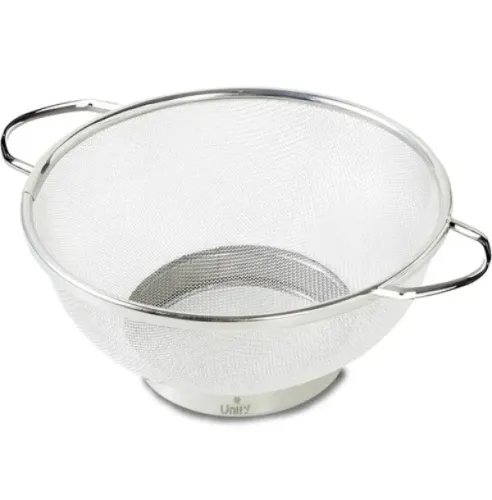
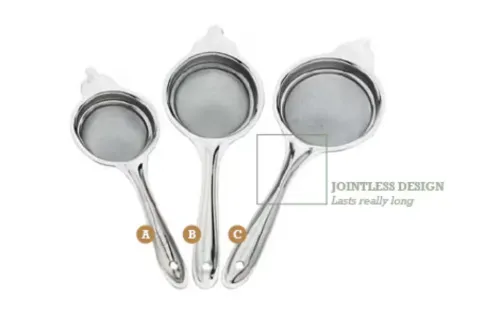
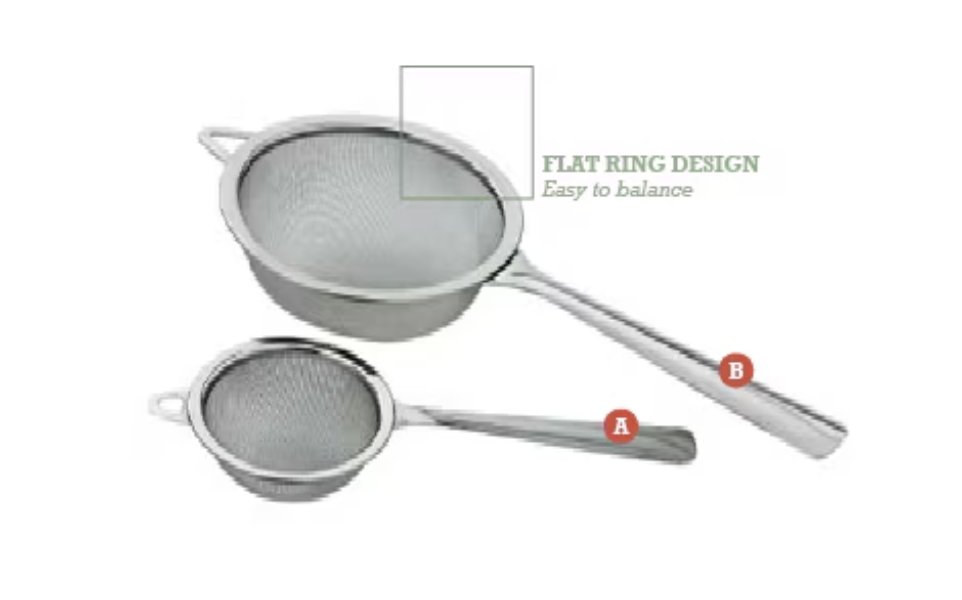
The strainer should therefore be comfortable to handle and appropriately constructed for its intended workload. Check the mesh attachment, surrounding frame, handle connection, dimensions, and finishing.
A sample allows the actual kitchen team to evaluate the product under realistic conditions.
Cleaning Requirements Matter
Fine mesh products need appropriate cleaning because particles can become trapped within the openings.
Before selecting a design, consider whether it can be cleaned effectively using the establishment's normal procedure.
Staff should follow appropriate cleaning and drying practices based on the material and intended use. Regular inspection can identify mesh damage, deformation, or loose components before these issues affect routine preparation.
Buyers Should Evaluate Supply Consistency
For dealers and food-service groups, the initial product is only part of the purchasing decision.
A manufacturer should also be assessed for:
- Specification consistency
- Available dimensions
- Order quantities
- Product range
- Packaging
- Repeat production
- Commercial communication
- Dispatch capability
Mumbai's hospitality and food-service sector creates demand from independent cafés as well as larger restaurants, hotels, caterers, and suppliers. Buyers serving customers throughout Maharashtra may therefore value reliable repeat availability.
Be Ready With a Clear Purchasing Requirement
The most productive manufacturer enquiry is specific.
Unistar Kitchen Strainers supplies strainers and related kitchenware for different commercial requirements. A café, distributor, hotel, restaurant, exporter, or catering company evaluating a coffee strainer manufacturer should ideally provide its intended use, dimensions, mesh expectations, quantities, and packaging needs at the beginning of the discussion.
This allows both buyer and manufacturer to focus on a suitable specification instead of treating coffee strainers as a one-size-fits-all product.